
Chelsea for Art, Food, and a Long Walk
A practical route through Chelsea combining world-class contemporary art galleries, indoor food options, and the elevated High Line park.

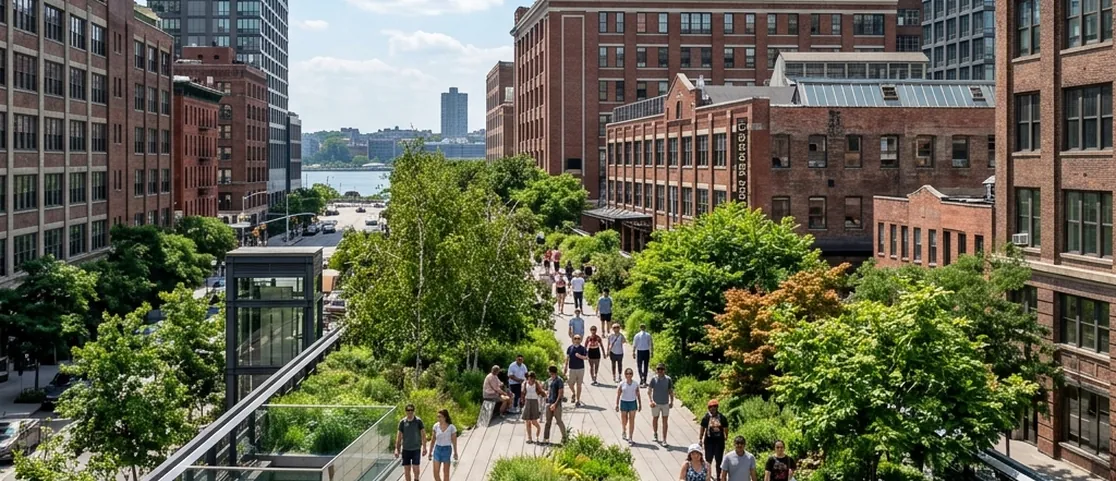
⚡ At a Glance Overview
Open the Route in Google Maps
These links map the guide’s walking skeleton. Re-check current closures, access rules, weather, and your group’s energy before following a route turn by turn.
Chelsea Market → High Line → gallery district
A south-to-north skeleton that avoids repeated avenue crossings. Gallery hours still need a same-day check.
- Chelsea Market
- High Line at W 16th St
- High Line at W 23rd St
- W 24th St & 10th Ave gallery grid
Google Maps is an external service. A mapped line is a navigation aid, not a guarantee that every path, elevator, park entrance, or venue is open when you arrive.
Why We Chose This
Chelsea is easiest to plan as three adjacent but different experiences: gallery streets, the High Line, and food. The repair teaches when to combine them, when to cut one, and how to avoid spending the whole visit in crowd bottlenecks.
Editorial Notes & Caveats
Gallery opening days, exhibition schedules, market vendors, and High Line access conditions change. If a specific gallery or elevator entrance matters, verify it on the venue or park’s official site before the walk; the route should still work when one stop is closed.
Chelsea is Manhattan’s epicenter for contemporary art, but visiting without a plan can lead to exhaustion. The neighborhood is geographically massive compared to older downtown districts like the West Village. The avenues stretch long distances, the cross streets are industrial, and the galleries themselves are spread out across several massive blocks.
When people attempt to visit Chelsea without a distinct strategy, they often find themselves zig-zagging endlessly between 10th and 11th Avenues, burning through their physical energy before they even see the art they came for. This guide establishes a practical, directional route that groups your activities logically. Instead of bouncing back and forth, you will combine world-class art, distinct food options, and the elevated High Line park in a single, smooth sequence.
The Art Gallery Strategy
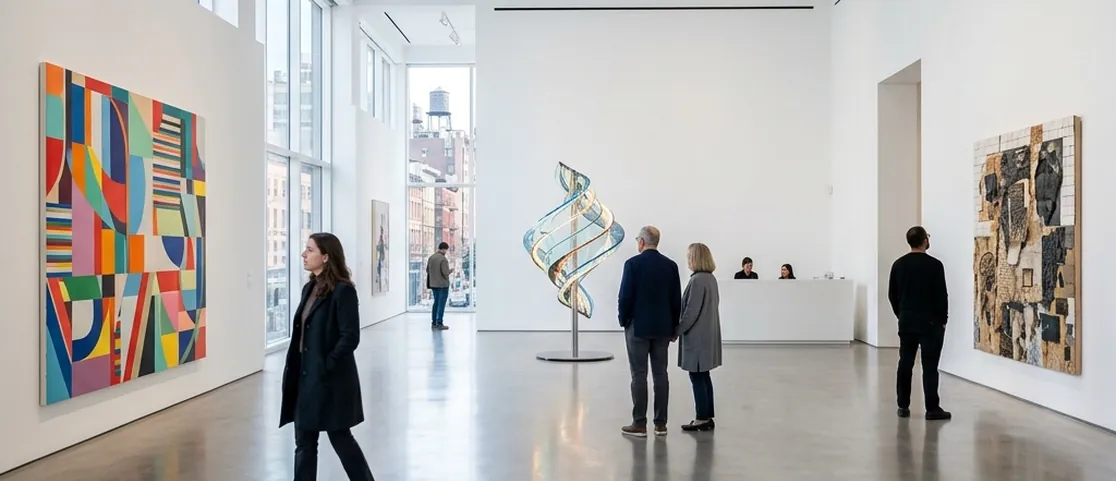
Most major commercial galleries in Chelsea are located in a dense grid between 10th and 11th Avenues, spanning roughly from 18th Street up to 28th Street. This area anchors the contemporary art world in New York, housing international powerhouses like David Zwirner, Gagosian, and Pace Gallery.
The most important rule for navigating this district is to commit to a single direction. Start at 19th Street and work your way north, or start at 24th Street and work your way south. Do not cross avenues multiple times. Walk entirely down the north side of a street, cross the avenue, and walk back up the south side of the next street.
Unlike museums, these commercial galleries are entirely free to enter and require no tickets or advance reservations. You can simply push open the heavy glass doors and walk inside. The environment can sometimes feel intimidating, with silent reception desks and stark white walls, but these spaces are legally required to be open to the public during operating hours. Do not let the quiet atmosphere deter you.
Timing is critical. Almost every contemporary art gallery in Chelsea is closed on Sundays and Mondays. If you attempt this route on a Monday, you will encounter locked doors and roll-down gates. The standard operating hours are Tuesday through Saturday, typically from 10:00 AM to 6:00 PM. Furthermore, many galleries take an extended summer break in August, either closing entirely or operating on significantly reduced hours.
Integrating Chelsea Market
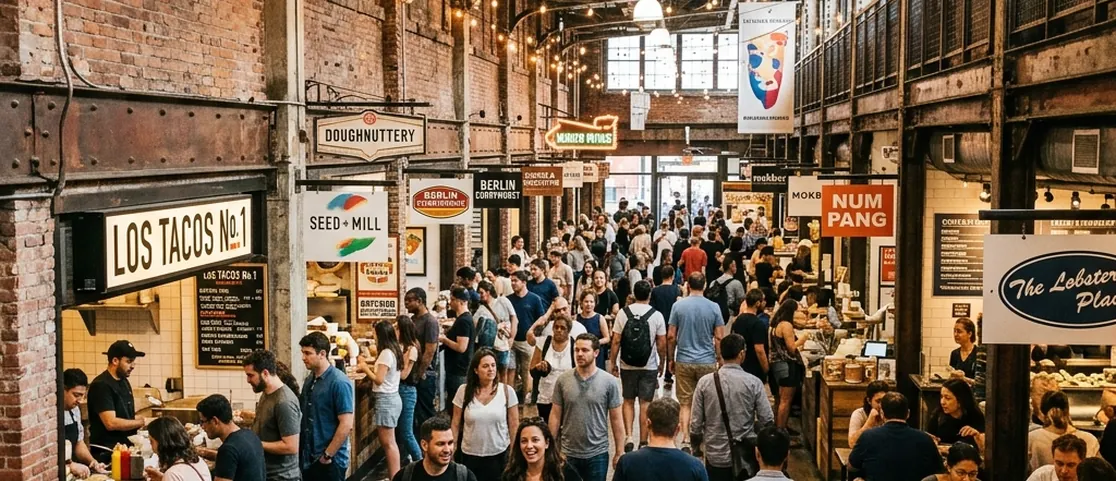
Located at 9th Avenue between 15th and 16th Streets, Chelsea Market is an ideal starting or ending anchor for your day. Built inside a massive historic Nabisco factory complex, it offers a dense collection of independent food vendors, bakers, and retailers under one roof. This makes it particularly useful for groups who cannot agree on a single restaurant, as everyone can acquire their preferred meal and reconvene.
However, Chelsea Market is not a hidden secret; it is one of the most heavily trafficked indoor spaces in Manhattan. On weekends and rainy days, the narrow brick corridors can become overwhelmingly crowded. To manage this, timing is your best defense. Plan to arrive for lunch slightly before the peak rush (around 11:30 AM) or wait until the late afternoon (after 2:30 PM).
When selecting food, prioritize distinct vendors rather than generic concepts. Seek out options like Los Tacos No.1, which regularly draws a fast-moving line for exceptional adobada tacos, or Very Fresh Noodles for hand-pulled Chinese dishes. Note that seating is notoriously scarce inside the market. You may need to take your food outside or eat while standing at high-top counters. If you require guaranteed table service and a calm environment, Chelsea Market is not the right choice for that specific meal.
The market also serves as a critical logistical stop. It contains reliable, albeit busy, public restrooms in the basement level, making it a crucial pit stop before you begin a long gallery walk or head up to the High Line.
Walking the High Line
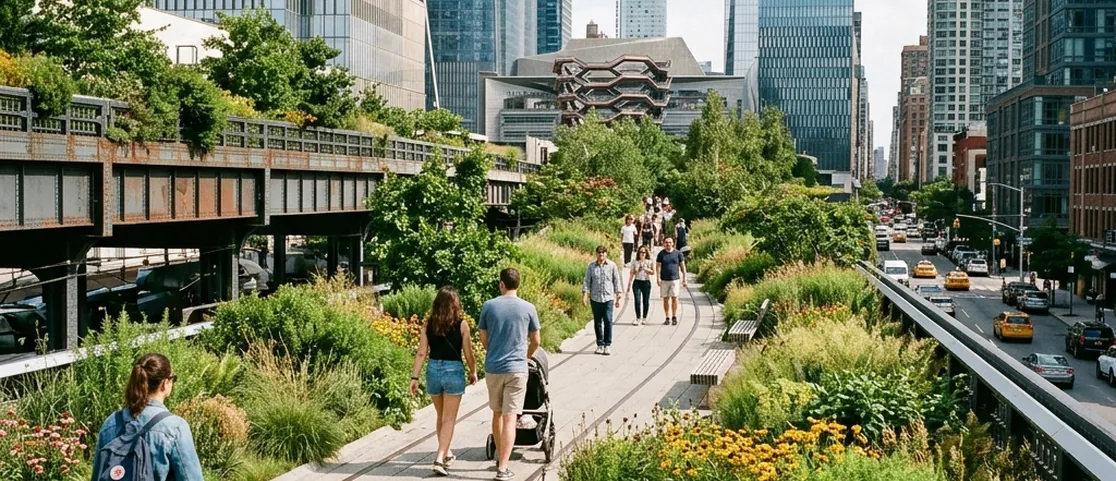
The High Line is a public park built on a historic, elevated freight rail line that winds above the streets of the West Side. It offers unique, elevated vantage points of the city infrastructure, the Hudson River, and the surrounding modern architecture. It serves as an excellent, car-free thoroughfare connecting the Meatpacking District, Chelsea Market, and the gallery district.
You can easily integrate the High Line into your Chelsea itinerary by using the staircase or elevator access points located along 10th Avenue. A popular approach is to eat at Chelsea Market, access the High Line at the 14th Street or 16th Street entry points, and walk north until you reach the 20s, where you can descend directly into the gallery grid.
While the High Line is visually stunning, it is important to manage your expectations regarding the experience. Because the pathway is physically narrow and bordered by protected greenery, it acts as a funnel for foot traffic. On sunny weekend afternoons, walking the High Line can feel less like a relaxing park stroll and more like a slow-moving conveyor belt. If your goal is to sit quietly on the grass or let children run freely, this is not the appropriate park.
For accessibility, the High Line is fully wheelchair accessible, with reliable elevators located at key junctions, including 14th Street and 23rd Street. If the crowds on the High Line become unbearable, your best immediate alternative is to descend to street level and walk one avenue west to Hudson River Park, which offers wide, flat, paved paths directly alongside the water.
In foul weather, Chelsea galleries still work inside the indoor winter hubs.
The High Line is a good last-day loop if luggage is stored; see checkout to an evening flight.
Start north of the galleries with a quiet breakfast.
Decide which Chelsea you actually came for
Chelsea can mean contemporary art, an elevated park walk, a food stop, or a convenient west-side connector. Trying to give all four equal weight produces a scattered day. If art is the primary intent, begin with the gallery streets while attention is fresh and let the High Line become the exit. If the walk is the point, use one or two galleries as texture rather than turning every open door into an obligation.
Food should usually support the route, not interrupt it. Chelsea Market is useful when the group wants choice, shelter, or an easy reset, but entering at the busiest moment can consume more time than the meal deserves. If you already have a dinner plan elsewhere, a coffee or quick snack may preserve the better part of the afternoon.
Treat the gallery district as a few blocks, not a checklist
The gallery area is valuable because many spaces sit close together and can be entered briefly. Pick a small number of shows that genuinely interest you, then allow room for one unexpected stop. A visitor who tries to inspect every gallery frontage quickly reaches visual fatigue and starts moving through art only to maintain momentum.
If you do not follow contemporary art, you do not need to pretend otherwise. Choose one accessible gallery experience, then shift to architecture, the High Line, or the waterfront. Chelsea is still worth visiting without turning the afternoon into a test of cultural stamina. The page should help you spend attention deliberately, not maximize the number of white rooms entered.
Use the High Line as a connector with a planned exit
The High Line is narrow enough that crowd density changes the experience. Enter because the elevated perspective or north-south connection helps the day, not simply because the park is famous. Decide in advance where you will leave. Without an exit, visitors often continue farther than intended and then discover that the next meal, gallery, or subway entrance is back in the direction they came from.
A shorter segment can be more useful than walking the entire park. If the path is crowded, the weather is exposed, or the group is tired, exit early and continue at street level. The point is the changed view of Chelsea, not completing a linear attraction from one end to the other.
Build the rainy-day and closed-gallery version
Chelsea needs a second plan because the three parts of the neighborhood respond differently to weather and opening patterns. On a wet day, spend more time in a market, museum, or a small set of confirmed galleries and treat outdoor walking as the connective tissue. On a day when many galleries are closed, do not roam shuttered blocks hoping the neighborhood will behave like it does at peak gallery hours.
Instead, make the High Line, waterfront, architecture, or a nearby indoor attraction the primary anchor. This keeps the page useful beyond one ideal weekday afternoon. A robust neighborhood guide should survive a closed door without sending the reader to a different borough.
Know when to skip Chelsea
Skip the neighborhood on a short first visit if no one in the group cares about art, the weather makes the elevated walk unpleasant, and the food stop is the only remaining reason to go. Chelsea Market by itself rarely justifies crossing Manhattan when an equally useful meal sits beside the day’s real anchor.
Chelsea becomes stronger when it links two things you already want: art plus a walk, a west-side final day plus stored luggage, or a seasonal High Line visit plus an easy meal. That combination logic is the reason to choose the neighborhood. If you need to invent three extra stops to make the trip feel worthwhile, choose a different cluster.
A clean three-hour Chelsea version
With about three hours, choose one primary mode and one secondary mode. An art-first visit can spend roughly the first half in a compact gallery loop, pause for food or coffee, then use a short High Line segment as the exit. A walk-first visit can enter the High Line at the end that best matches the rest of the day, leave after the strongest segment, and use one gallery or market stop at street level.
Do not schedule a ticketed attraction on both sides of this window. The point of Chelsea is that the parts can breathe. If you need to leave for a Broadway curtain, airport transfer, or dinner reservation, work backward and choose the High Line exit accordingly. The most common waste is reaching the wrong end of the elevated park and then paying for a crosstown correction.
If the group loses interest in galleries, stop opening gallery doors. If the High Line is unpleasantly crowded, leave it. If the market is packed, eat elsewhere. Chelsea works because each component has an alternative within the same geography. Use that flexibility instead of treating completion as the goal.
For visitors with limited mobility or anyone who dislikes stairs, decide the street-level route first and treat elevated access as optional until the current elevator situation is confirmed. Chelsea still works without completing the High Line: gallery blocks, food, and the river edge can be connected at street level. Accessibility should change the path, not force the neighborhood out of the itinerary.
Suggested Route & Mini Plan
1. Arrive around 11:30 AM to grab lunch at Chelsea Market before the peak crowds arrive.
2. Take the stairs or elevator near Chelsea Market to the High Line and walk north towards the 20s.
3. Exit the High Line at 20th or 23rd Street and spend the afternoon exploring the free galleries between 10th and 11th Avenues.
Curated Alternatives
Hudson River Park
If the High Line is too crowded, walk one avenue west to Hudson River Park for wide, flat pedestrian paths right along the water.
The Whitney Museum
Located at the southern end of the High Line, this is a great paid alternative if the free gallery district feels too spread out.
Frequently Asked Questions
Do I need tickets for the Chelsea art galleries?
No. The commercial art galleries in Chelsea are completely free and open to the public without tickets or reservations.
Is the High Line accessible?
Yes. The High Line is fully wheelchair accessible, and there are several elevator access points along the route, including at 14th Street and 23rd Street.
Where can I find public restrooms in Chelsea?
Chelsea Market has reliable public restrooms, though there is often a line. The High Line has restrooms at the 16th Street access point.
Our recommendations are handpicked independently. No paid placement, no sponsored rankings. How we choose