
Planning a Birthday Dinner in Manhattan: How to Choose the Right Place
A birthday-specific Manhattan dining guide for choosing the right celebration format, reservation path, room type, cake policy, noise level, and after-dinner geography without relying on one-size-fits-all group rules.

⚡ At a Glance Overview
Why We Chose This
The refreshed guide separates birthday design from general group-dining mechanics. It routes by celebration type, headcount, noise/conversation needs, cake/speech/decor requirements, booking channel, and after-dinner geography instead of assuming fixed price, deposit, cake-fee, or payment rules across Manhattan.
Editorial Notes & Caveats
Birthday policies are venue-specific. Never assume outside cake, candles, decorations, corkage, separate checks, a specific number of cards, a private-room duration, automatic gratuity, or a refundable deposit. Ask the exact venue and keep the confirmation in writing when the term matters to the celebration.
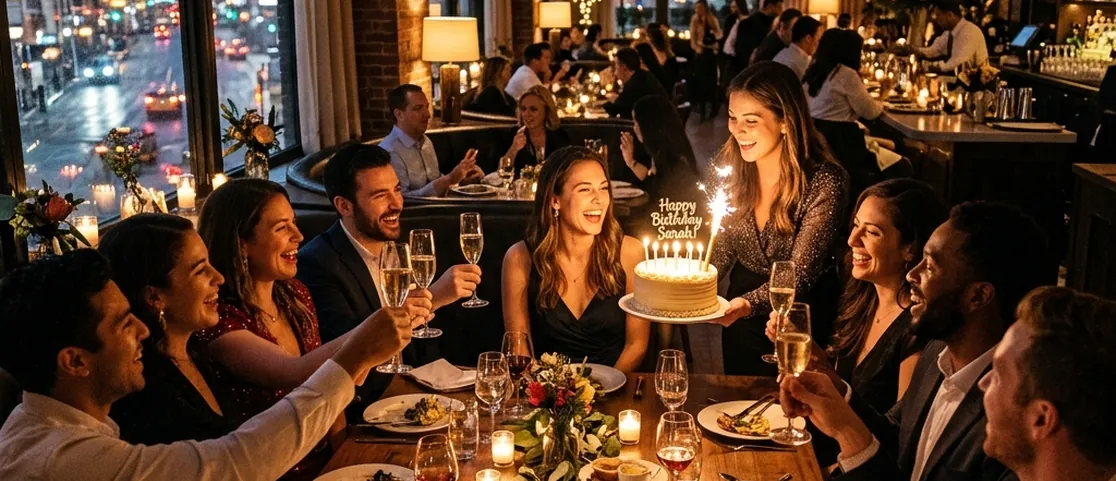
A birthday dinner is not just a large-party reservation with candles added at the end. The restaurant has to support the kind of celebration you actually want: quiet conversation, loud shared food, speeches, a cake reveal, photos, a private room, or an easy transition to drinks afterward. When those needs are unclear, hosts often choose a restaurant that looks celebratory online but fights the group all night.
The old version of this guide tried to solve birthday planning with fixed rules for booking lead time, party-size thresholds, cake fees, deposits, card splits, per-person budgets, and payment apps. Current restaurant policies show why that approach breaks. A party of seven can still be a normal reservation at one venue and already be group dining at another. A private room can begin at seven people in one event program and only make sense at much larger counts somewhere else.
The better order is birthday format first, then headcount, then venue operations. General large-party mechanics belong in the group-dining guide; this page focuses on the birthday overlay—the choices that make a celebration feel right rather than merely seated.
Step 1: decide what kind of birthday this is
Start with the emotional shape of the night. An intimate birthday for four people needs a table where everyone can hear one another. A group of ten friends may want shared food and energy. A milestone birthday may need a room where speeches and photos can happen without negotiating with neighboring tables. A dinner that is only the first act needs a neighborhood with an obvious next stop.
Do not ask “What is the best birthday restaurant?” before answering that. The same loud, interactive room can be perfect for one birthday and exhausting for another. The same beautiful private room can feel expensive and overproduced when six friends really wanted pasta and two bottles of wine.
Intimate birthdays: conversation is the feature

For two to five guests, the main advantage is flexibility. You can usually choose from the normal menu, fit into smaller rooms, and move neighborhoods more easily after dinner. Prioritize table shape, noise, lighting, and whether the meal encourages lingering conversation rather than automatically choosing the most famous celebratory restaurant.
The West Village is useful for this birthday style because the dinner can transition into a walk, dessert, or one drink without a complicated transfer. But geography should follow the group. If everyone is already in Midtown or downtown, crossing Manhattan for atmosphere can consume the very time that made the small dinner attractive.
A small birthday also makes surprises easier to coordinate. One person can arrive early, confirm a dessert plan, or ask the host stand about a candle without turning the restaurant into an event-production operation. Keep the plan proportional to the group.
Shared-energy birthdays: make the meal the activity
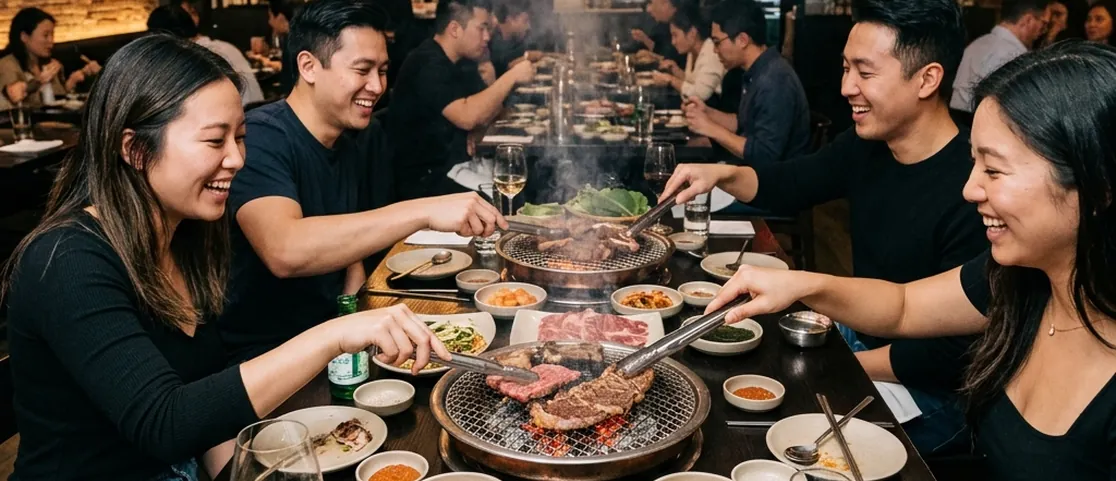
Interactive or shared-food formats work when the birthday group wants energy and a built-in activity. Korean barbecue is the clearest example because the table experience itself drives the evening. Current COTE NYC event information shows how party size can change the booking format: standard reservations currently accommodate up to six guests, while parties of seven to eighteen use a group-dining path.
That operational threshold is more useful than a generic rule that “eight people need a prix fixe.” It tells the host when the restaurant itself changes the product. Once the party crosses into group dining, ask what menu applies, how long the table is held, what is prepaid or guaranteed, and how changes to headcount are handled.
Shared-energy dinners are weaker when several guests dislike the format, when conversation across the table matters, or when dietary restrictions make a communal grill or family-style menu complicated. The birthday person should enjoy the activity; it should not become an obligation for the rest of the group.
Milestone birthdays: decide whether you need a room or just a table
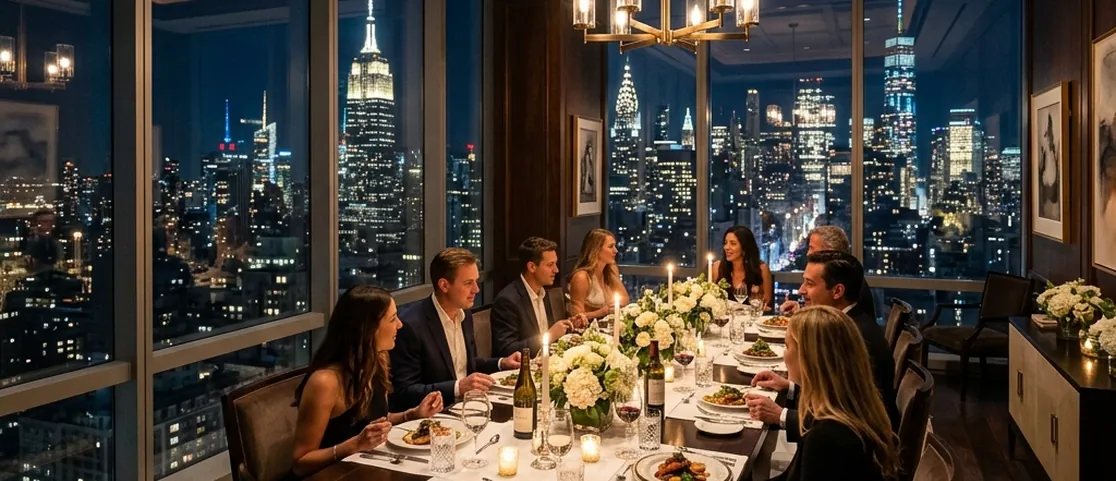
A milestone birthday often raises the question of private dining. The useful test is not age or headcount alone. Ask what the room solves. Does someone need to make a speech? Will there be a slideshow or presentation? Do you need a predictable seating chart, room for gifts, a quieter environment, or a place where a photographer can move without blocking another table?
Manhatta currently markets private-event spaces specifically for celebrations including birthdays. Its private-event inquiry starts at seven guests, and individual rooms publish seated and standing capacities. Quality Italian also currently offers multiple private-event rooms, including spaces for roughly thirty to sixty seated guests and larger combinations. These are examples of event products, not evidence that every birthday over a fixed size should book private dining.
Private rooms can add control, but control comes with terms. Ask about food-and-beverage minimums, fixed or customized menus, deposits, cancellation deadlines, room duration, service charges, staffing, AV, accessibility, cake service, and whether the space is truly private or semi-private. Never assume a private room means unlimited time.
Step 2: headcount has to be real enough to quote
Birthday guest lists are notorious for “maybe.” Restaurants cannot plan around social ambiguity. Ask invitees for a firm response by a date that gives the venue time to adjust. If the count may still move by one or two people, tell the restaurant that when you inquire and ask what flexibility exists.
A stable headcount matters even more for fixed menus or private events because pricing, table layout, and minimum spend may depend on it. Do not collect a deposit from friends based on one number and then discover that the venue charges the host for late cancellations under a different number.
For general large-party reservation mechanics, use the separate group-dining guide. For the birthday decision, the key question is whether the final count changes the celebration format—from normal table to group menu, from one table to adjacent tables, or from public dining room to event inquiry.
Step 3: cake, candles, and decorations need explicit permission
Outside cake is one of the most common birthday assumptions and one of the easiest places to create friction. Ask before buying or carrying anything. The venue may allow outside cake, prohibit it, offer its own celebration dessert, charge for service, require advance delivery, lack refrigerator space, or restrict candles because of building or fire-safety rules.
Ask the whole cake question at once: Can we bring it? When can it arrive? Can you refrigerate it? Are candles allowed? Will staff cut and serve it? Is there a fee? Can we bring a cake stand or topper? What happens if the cake is delivered before the reservation? Written answers are much more useful than a vague “should be fine” phone memory.
Treat decorations the same way. Balloons, confetti, table signs, flowers, candles, and wall decorations may be limited even in private rooms. A restaurant is not automatically an event venue just because the group is celebrating.
Step 4: choose the noise level before choosing the look
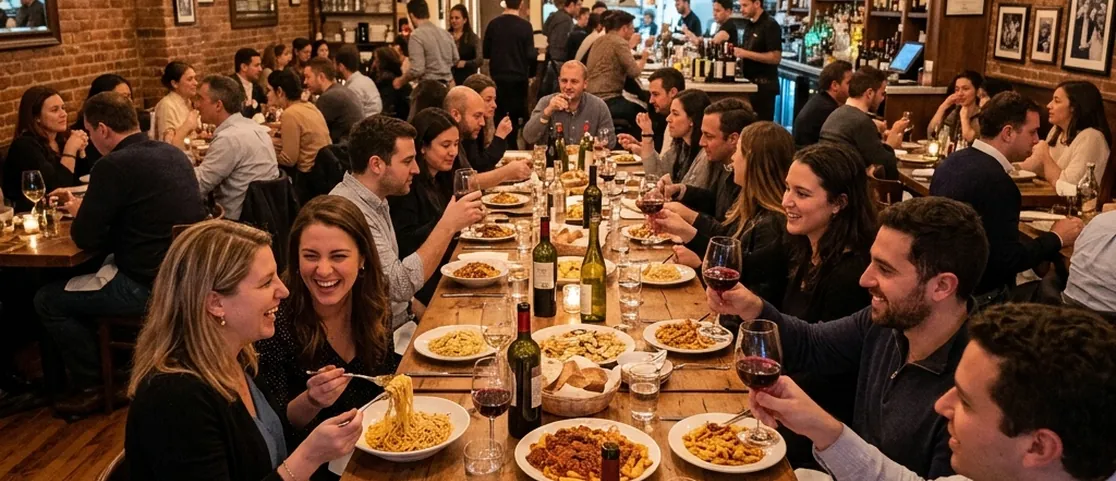
Birthday photos can make a restaurant look ideal even when the acoustics are wrong for the group. Decide whether guests need to hear across the table. If grandparents, parents, coworkers, or people meeting for the first time are attending, conversation may matter more than a dramatic room. If the group is already close and wants a loud shared meal, energy can be an asset.
Ask the restaurant where a large party is normally seated. A corner booth, long communal table, private room, patio, or standing area each changes the social experience. “Can seat twelve” does not tell you whether twelve people can speak to one another.
For mixed-age groups, also ask about stairs, elevator access, restroom location, seating height, and how much standing is required before the table is ready. Celebration quality is often determined by these practical details rather than décor.
Step 5: read event terms before falling in love with the room
Private-event and group-dining proposals can include a deposit, minimum spend, menu commitment, cancellation schedule, service charge, room fee, tax, staffing cost, or payment deadline. The exact structure varies. Compare the all-in commitment, not just the first price on the menu.
Ask what happens if the group shrinks, if the birthday person gets sick, or if a flight delay changes arrival time. A strict cancellation term may be perfectly acceptable when the group is stable and the occasion matters. It is a poor fit when half the guest list is traveling from out of town and still has uncertain plans.
Do not assume how the final bill can be divided. Normal restaurant tables and event contracts can use different payment systems. If the group needs separate checks, several cards, one corporate receipt, or one host payer, confirm the arrangement before the night.
Step 6: geography should include the after-dinner plan
Birthday geography is different from ordinary restaurant geography because dinner often has a second act. If the group wants cocktails afterward, choose an area where the transition is walkable. If the party includes parents or children, the best second act may be nothing—make the restaurant easy to reach from hotels and transit instead.
Midtown works well when guests are coming from different parts of the city or staying near major hotels and transit. The West Village works when a walk or another drink is part of the celebration. Chinatown can work for a shared-food birthday that stays downtown. Do not choose a restaurant first and then force fifteen people through a cross-town transfer because the after-party happens elsewhere.
If a private room is the main event, the neighborhood matters less because the room itself carries the celebration. In that case, prioritize guest arrival, accessibility, and the route home. A skyline event space in Lower Manhattan can be worth the trip for a milestone even when it would be unnecessary for a casual six-person dinner.
Four birthday formats that solve different problems
Format A: intimate dinner for two to five
Choose a normal reservation, conversation-friendly room, and a neighborhood with an easy post-dinner walk or dessert. Keep cake logistics simple; the restaurant’s own dessert may be enough.
Format B: energetic shared meal for six to twelve
Choose a communal format only when the group likes it. Confirm whether the party size moves into group dining, whether a fixed menu applies, and whether the seating still allows the birthday person to interact with the whole group.
Format C: milestone room for speeches and photos
Use a private or semi-private inquiry when control over seating, sound, timing, presentation, cake, or décor is worth the additional contract terms. Compare the full event proposal, not just menu price.
Format D: dinner plus after-party
Pick the second location or neighborhood before locking dinner. Keep the walk short, protect the dinner end time, and avoid a reservation structure that traps the group far from the next part of the birthday.
The host message that prevents birthday chaos
Once the venue is confirmed, send guests one clear message: exact restaurant and address, arrival time, whether the reservation waits for a complete party, expected meal format, any dress requirement from the venue, what happens after dinner, and whom to contact if they are late. Keep payment instructions neutral until you know the restaurant’s actual rules.
The birthday person should not spend the night answering logistics questions. One organizer should own the reservation, final headcount, cake coordination, and venue contact. That is the most reliable way to make the dinner feel celebratory rather than administrative.
The decision in one line
Design the birthday before choosing the restaurant: define the energy, headcount, cake/speech/private-room needs and after-dinner plan, then book through the venue’s actual group or event workflow and accept only the terms that fit the celebration.
Suggested Route & Mini Plan
1. Define the birthday: intimate dinner, high-energy shared meal, milestone/private room, or dinner plus an after-party.
2. Freeze the best available headcount and ask which booking channel applies to that size.
3. Confirm cake/candles, speeches, decorations, accessibility, fixed-menu, minimum-spend, cancellation, and payment terms before paying anything.
4. Choose a neighborhood that works for what happens immediately after dinner, not just for the restaurant itself.
5. Send guests one address, one arrival time, one organizer contact, and any dress/payment expectations that the venue actually requires.
Curated Alternatives
Drinks-first birthday
Choose a cocktail-led celebration when the group wants movement and mingling more than a formal meal. Confirm age, standing-capacity, cake, minimum-spend, and reservation rules before treating a bar as an easier substitute for dinner.
Activity plus simple dinner
Choose an activity first and a nearby uncomplicated meal when the birthday memory should come from a show, museum, karaoke room, or other shared experience rather than from restaurant production value.
Frequently Asked Questions
At what party size should I ask about group dining or private events?
Use the restaurant’s own threshold. Current COTE NYC examples show standard reservations up to 6 guests and a separate group-dining path for 7–18, while Manhatta’s private-event inquiry starts at 7 guests. Other restaurants use different cutoffs.
Can I bring a birthday cake to a Manhattan restaurant?
Sometimes, but there is no reliable citywide rule. Ask whether outside cake is allowed, whether the restaurant can store it, whether candles are permitted, whether there is a service fee, and whether the venue offers its own dessert alternative.
When is a private room worth it for a birthday?
A private or semi-private room is most useful when speeches, photos, a stable seating plan, decorations, presentation equipment, or acoustic separation matter enough to justify the event terms. It is not automatically necessary just because the party has more than ten people.
Our recommendations are handpicked independently. No paid placement, no sponsored rankings. How we choose