
Pilates in Manhattan: How to Choose a Studio and Class
A practical Manhattan Pilates guide for choosing between classical and contemporary reformer classes, beginner pathways, privates, and Pilates-inspired strength formats without treating every studio rule as universal.

⚡ At a Glance Overview
Why We Chose This
The refreshed guide separates actual Pilates from Pilates-influenced boutique strength formats, then routes by first-timer requirements, instruction needs, pace, geography, and studio-specific booking policies instead of price or brand-name hype.
Editorial Notes & Caveats
This is class-selection advice, not medical or rehabilitation guidance. If you are pregnant, injured, in pain, recovering from surgery, or have another condition that changes exercise safety, use appropriate professional guidance and read the studio’s participation rules before booking. Grip-sock, late-arrival, cancellation, prerequisite, and pregnancy policies vary by studio.
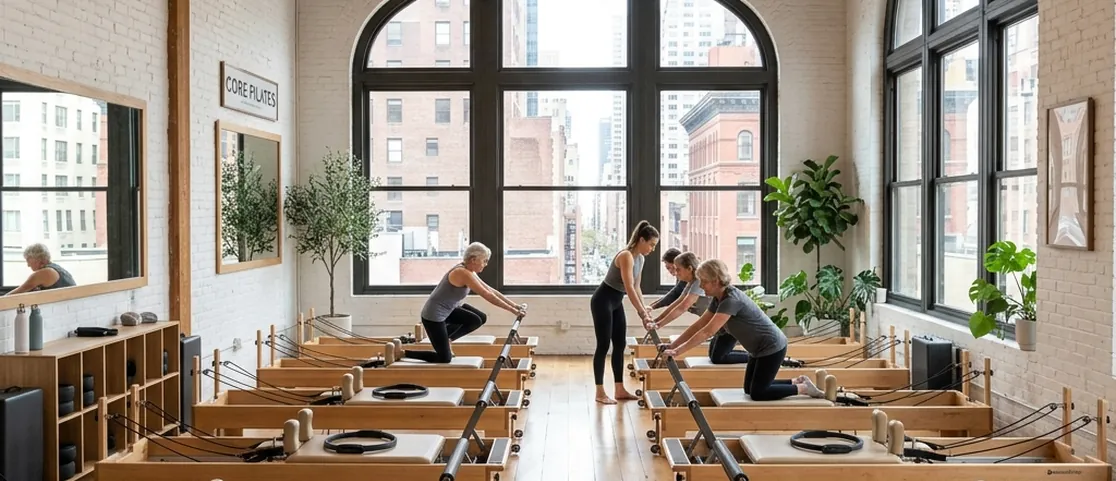
The hardest part of booking Pilates in Manhattan is not finding a studio. It is recognizing that similar-looking machines can represent very different classes. A classical apparatus session, a contemporary reformer flow, an SLT Megaformer class, and a [solidcore] strength workout may all appear in the same search results, but they do not ask the same thing from a first-time client.
The old version of this guide flattened those differences into four “Pilates styles,” attached one price range and one cancellation rule to the whole city, and implied that grip socks were universally mandatory. That is not how the current market works. Studios set their own prerequisites, late-arrival rules, cancellation windows, pregnancy policies, package terms, and class-level systems.
The useful decision is therefore sequential: first identify the training format, then the beginner pathway, then the amount of individual instruction you need, then the booking rules, and only after that compare price and time. This prevents the common one-off visitor mistake of buying the cheapest introductory pack before realizing the studio requires a prerequisite or the class format is not what they expected.
Step 1: decide whether you actually want Pilates
If you want Pilates, look for a studio that describes its classes as Pilates and explains the apparatus, levels, and teaching approach. Classical studios tend to emphasize a more traditional exercise system and apparatus sequence. Contemporary studios may vary the order, music, pacing, and programming while still teaching reformer Pilates. Neither label automatically tells you which class will feel easier or better; the actual level description matters more.

Real Pilates is a useful current example of a prerequisite-driven classical studio. Its FAQ says first-time visitors must complete the studio’s introductory group class or a private session before joining apparatus-based group classes, unless an experienced classical client submits for an exception. That rule is more important to a traveler than whether the reformer brand or studio aesthetic looks “authentic.”
If what you really want is high-intensity resistance work on a reformer-like machine, do not force that choice into the Pilates category. [solidcore] currently says directly that it is not Pilates; it describes its workout as high-intensity, low-impact strength training on a Pilates-inspired reformer. That may be exactly what you want, but the distinction helps set expectations before class.
Step 2: choose the beginner pathway before the brand name
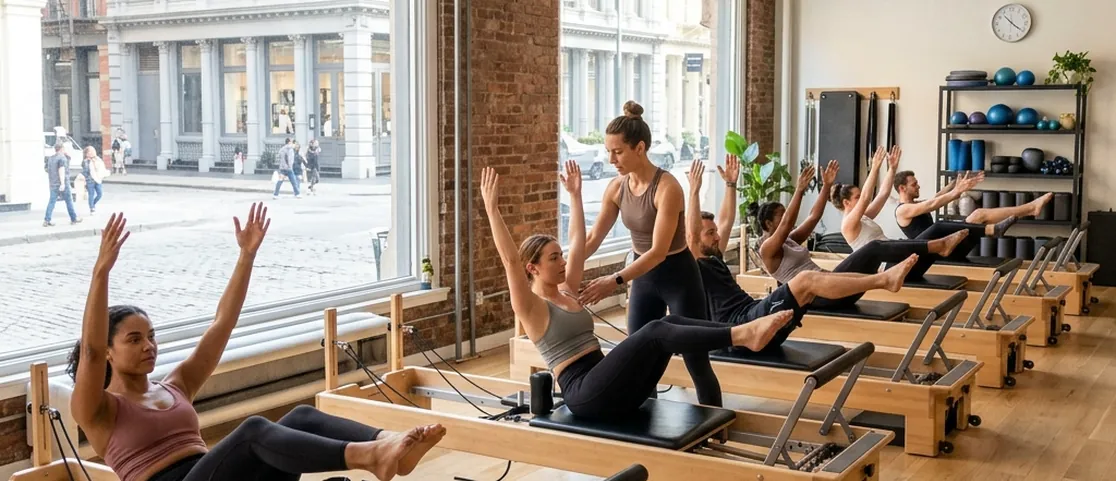
For a first machine-based class, the best booking is usually the format the studio designed for first-timers. That might be an orientation class, a beginner reformer class, or a private session. Do not assume “all levels” means the instructor can stop a full room to teach you every spring, strap, carriage, and transition from zero.
SLT currently tells new clients to arrive ten minutes early for waiver, studio tour, instructor introduction, and machine demo. It also offers an Essentials class specifically for clients who are new or relatively new, with a slower pace and more detailed explanations. That is a clearer first-class signal than simply choosing the earliest available slot.
A private session can make sense when you want slower equipment orientation, individualized instruction, or a studio requires it as part of entry. It is not automatically necessary for every healthy beginner. Read the studio’s own entry rules and ask whether the first group class is designed for new clients before paying for a private by default.
Step 3: group, private, or duet is an instruction decision
A group class trades individual attention for a lower per-session price and a more social schedule. A private session buys the instructor’s full attention and can make equipment setup, pacing, and questions simpler. A duet can split the difference when two people want the same appointment and the studio supports paired sessions.
For a traveler, geography can matter more than the theoretical quality difference between two reputable studios. If your hotel is downtown, a Tribeca class that matches your level may be a better decision than commuting to the Upper East Side because a blog ranked that location first. The workout occupies one hour; the round trip can quietly occupy another.
Also check whether the session type fits your party. Some private or duet policies require a partner to be arranged in advance, and some studios do not automatically pair strangers. Do not assume a “duet price” means the studio will supply the second person. If two travelers have very different experience levels, separate beginner-appropriate bookings can be simpler than forcing both into one session format.
Step 4: treat grip socks and arrival rules as studio-specific
Grip socks are common, but the safe editorial rule is “check the studio,” not “all Manhattan studios require them.” Real Pilates currently requires grip socks for its classes, and SLT says grip socks are required for safety and sanitary reasons. Those are verified examples, not a city ordinance.
Arrival rules matter because machine classes usually begin with setup and a warm-up. Real Pilates currently says clients five or more minutes late are not admitted. [solidcore] also says clients who arrive five or more minutes late may not enter. If you are fitting a class between airport arrival, hotel check-in, or a museum reservation, leave more buffer than you would for an ordinary open-gym workout.
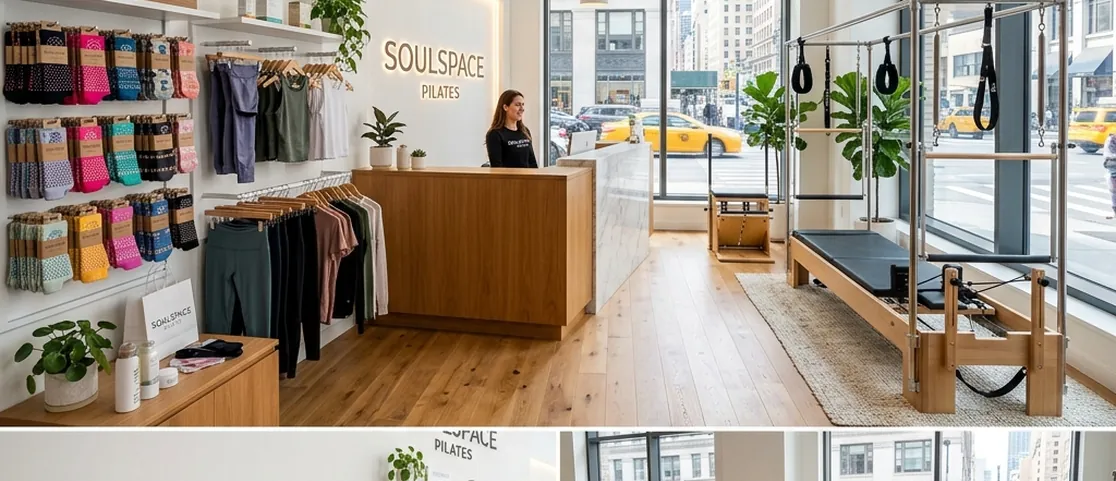
Pack what the specific studio requests and avoid buying accessories based on a generic Manhattan checklist. If grip socks are required and you already own them, bring them. If the studio permits regular socks or has another rule, follow that. Retail prices at reception change often and are not a useful reason to choose one studio over another.
Step 5: read cancellation economics before buying a package
Cancellation windows are not uniform. New York Pilates currently allows changes or cancellations without charge up to twelve hours before class, with different consequences for later changes and missed reservations. SLT’s current terms also use a twelve-hour cancellation window for Megaformer classes. [solidcore] currently uses a ten-hour window and says fees vary by client type, studio, and timing.
Those differences make package value highly personal. A discounted multi-class first-client package is only a bargain if you will use it before expiration and can reliably make the booked times. For a short Manhattan trip, one full-price class can be cheaper than losing two promotional credits because your itinerary changed.
Before checkout, read four things: expiration date, cancellation window, no-show consequence, and whether the package is limited to one location or class type. Do not rely on an old article’s dollar range because boutique pricing and promotions move much faster than the underlying class decision.
Classical vs contemporary: use the level description, not stereotypes
Classical Pilates is often marketed around traditional sequencing and apparatus, while contemporary reformer classes may use different programming, music, props, or transitions. That distinction can help narrow the search, but it should not become a medical promise. A class being “classical” does not by itself mean it will correct posture, rehabilitate pain, or be safer for an injury.
Likewise, a contemporary class is not automatically an easier aesthetic workout. Read the actual description. Look for words such as beginner, fundamentals, intermediate, advanced, athletic, jumpboard, tower, or mixed apparatus. If the language assumes you already know reformer transitions, choose a more introductory class rather than hoping the instructor can redesign the session around you.
Megaformer and Pilates-inspired strength: choose intensity on purpose
SLT’s current signature programming combines strength, cardio, and challenging Pilates elements on the Megaformer, while its Essentials format slows the pace for people new to the machine. That is different from walking into a classical apparatus studio and following a traditional Pilates sequence.

[solidcore] is an even clearer category boundary because the company itself says it is not Pilates. It uses a Pilates-inspired reformer for slow, resistance-focused strength training. If your search intent is “I want a hard boutique strength class,” that can be relevant. If your intent is “I want to try Pilates,” book Pilates instead of treating every spring-loaded carriage as interchangeable.
Do not use “low impact” as shorthand for “appropriate for every body.” Low-impact classes can still be demanding. If pain, injury, pregnancy, surgery recovery, or another health condition changes what exercise is appropriate, use professional guidance and the studio’s current participation policy rather than a tourism guide’s class taxonomy.
A one-class Manhattan decision tree
You have never used a reformer
Choose the studio’s explicit beginner or orientation pathway. Favor a location close to your hotel and leave enough arrival buffer for forms and machine setup. A private is worth considering when you want more individual instruction or the studio requires it.
You already take reformer Pilates at home
Compare method and level rather than “beginner versus not beginner.” If you know contemporary reformer but not a studio’s classical sequence, ask whether your experience satisfies its prerequisite. Real Pilates, for example, has a process for experienced classical clients who want to bypass the first-timer prerequisite.
You want the hardest possible boutique workout
Look at SLT or [solidcore]-style resistance formats, but recognize that intensity is now the primary decision, not Pilates authenticity. Choose the beginner version of the machine class if you do not know the equipment, even if you are generally fit.
You are fitting one workout into a trip
Book one class near where you already plan to be. Skip the package unless the math still works after expiration and cancellation risk. Avoid a class immediately after airport arrival or immediately before a timed attraction because strict late-entry rules can turn ordinary Manhattan delays into a lost credit.
The decision in one line
Choose actual Pilates versus Pilates-inspired strength first, then follow the studio’s beginner pathway, match group/private instruction to your experience, read the exact booking rules, and let geography beat brand prestige for a one-off Manhattan class.
If you want weights and a shower, compare a short-term gym.
A first class after a brutal itinerary may be the wrong day; see recovery pacing.
Suggested Route & Mini Plan
1. Decide whether you want actual Pilates or a Pilates-inspired strength workout.
2. Check the studio’s first-timer prerequisite or beginner class before comparing times and prices.
3. Pick group, private, or duet based on how much machine orientation and individual instruction you want.
4. Read the exact grip-sock, arrival, cancellation, waitlist, and participation policies before paying.
5. Choose the closest good-fit studio to your hotel or daily route; a one-off class rarely justifies a cross-Manhattan commute.
Curated Alternatives
Pilates-inspired strength training
Choose SLT or [solidcore]-style resistance training only if you want a more strength-focused, higher-intensity format. [solidcore] explicitly says it is not Pilates, even though it uses a Pilates-inspired reformer.
Mat class or regular gym workout
Choose a mat class or ordinary gym session when machine orientation, boutique cancellation rules, and a premium drop-in price add more friction than value for a one-off workout.
Frequently Asked Questions
Are SLT and [solidcore] the same as Pilates?
No. SLT describes a Megaformer workout that combines strength, cardio, and Pilates elements. [solidcore] explicitly says it is not Pilates and describes itself as high-intensity, low-impact strength training on a Pilates-inspired reformer. Choose them when that training style is what you want, not because the machines look similar.
Do all Manhattan Pilates studios require grip socks?
No universal rule applies to every studio. Real Pilates and SLT currently require grip socks, but you should check the exact studio and class policy before arriving instead of assuming a Manhattan-wide rule.
What should a first-time reformer student book?
Book the studio’s own beginner pathway. Real Pilates currently requires first-time visitors to complete its introductory class or a private session before apparatus-based group classes unless an experienced-client exception is approved. SLT offers an Essentials class for people new to the machine. Other studios use different level names and prerequisites.
Our recommendations are handpicked independently. No paid placement, no sponsored rankings. How we choose