
Grand Central: Twenty Minutes or a Real Stop?
Grand Central can be a five-minute walk-through, a focused twenty-minute stop, or a real 45–90 minute attraction. Choose by route fit, not fame.

⚡ At a Glance Overview
Why We Chose This
WhyManhattan already covers Midtown East after work, Morgan as a compact museum, indoor winter routing and one-day first-visit geography, but none owns the question of how much time Grand Central itself deserves. This page fills that gap without turning the terminal into a generic history catalog.
Editorial Notes & Caveats
Grand Central is an active transportation complex, not a museum lobby. Do not block passenger circulation for photos, and expect crowd levels to change quickly. Elevators and ramps provide access, but step-free routes through a large multi-level complex can take longer; check current MTA elevator status if access depends on a specific elevator. Grand Central does not provide luggage storage. Store and restaurant hours differ from terminal public hours.
Grand Central is one of the easiest Manhattan landmarks to overplan and one of the easiest to see well in a short amount of time. The building is already useful infrastructure: subway, Metro-North, LIRR at Grand Central Madison, buses, taxis, Midtown streets. That means the best visit often happens because you are already passing through—not because you sacrificed half a day to reach it.
For a first trip, there are three honest versions. Walk through in five to ten minutes if the terminal is already on your route. Give it about twenty minutes if you want the Main Concourse to register as a real place rather than a station transfer. Give it 45 to 90 minutes only when architecture, rail history, a deliberate meal, or the official tour is part of the point. Grand Central does not need a fourth category called “famous, therefore mandatory.”
The quick decision: route fit matters more than fame
- Five to ten minutes: Main Concourse, Information Booth Clock, celestial ceiling, then exit toward your real Midtown anchor.
- About twenty minutes: add one secondary feature such as Vanderbilt Hall or the Whispering Gallery and leave before shopping or dining turns into drift.
- Forty-five to seventy-five minutes: add the Lower Level, a deliberate coffee or food stop, market browsing, or architectural details at an unhurried pace.
- About ninety minutes: choose the official guided tour when the terminal itself—not merely the photo—is the attraction.
- Skip as a standalone detour: your day is elsewhere and you have no special interest in architecture, rail history or Midtown East.
If you are comparing Grand Central with several other paid or timed landmarks, start with the Attractions decision hub and decide which experiences deserve real blocks of the day.
A five-to-ten-minute walk-through is enough when Grand Central is already on the route
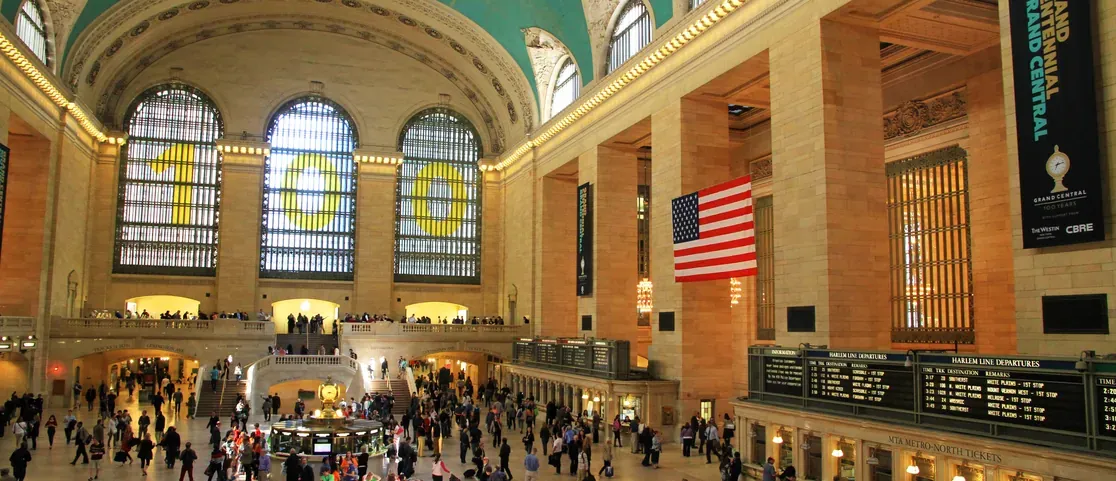
The short version works because the Main Concourse contains the visual reason most visitors came. Stand out of the passenger flow, look up at the celestial ceiling, register the four-faced Information Booth Clock, then continue toward 42nd Street, Vanderbilt Avenue, Lexington Avenue, the subway or your train. You have not “failed to see Grand Central” because you did not inspect every passage.
This is the right mode when you are moving between an east-side hotel and Midtown, arriving by Metro-North, changing to the subway, or crossing the 42nd Street corridor. The terminal adds architecture to a route you needed anyway. That is unusually high value in Manhattan: almost no extra geography and almost no scheduling risk.
If the terminal is only one part of a short first-day spine, fit it into the one-day first-visit plan instead of creating a separate cross-town mission just to collect the building.
Twenty minutes is the strongest first-trip default
Twenty minutes gives Grand Central a beginning and an end. Start in the Main Concourse. Take the ceiling and clock seriously instead of treating them as background. Then choose one secondary feature. The official Grand Central “What to See” list includes the Whispering Gallery, architectural details and the Park Avenue Viaduct among the terminal’s highlights. Pick one; do not turn the list into a scavenger hunt.
The Whispering Gallery is the obvious extension if you are traveling with another person and the Lower Level fits your exit. The Guastavino-tiled arches produce the acoustic effect that gives the space its name. But it should not force an awkward descent and retrace when your next destination is already north or west. The rule is still route fit.
If your next stop is outside on 42nd Street, Vanderbilt Hall or the exterior/Park Avenue side can be a better second feature. Twenty minutes is not a promise that every official highlight belongs in the same visit. It is a time box that protects the rest of Midtown.
A real stop begins around forty-five minutes
Grand Central becomes a real attraction when you start using its layers rather than just its Main Concourse. A 45-to-75-minute self-guided stop can include the ceiling and clock, a slower look at Vanderbilt details, the Lower Level and Whispering Gallery, then one deliberate food, coffee or market pause. That is enough to understand that the terminal is a building system, not merely a famous room.
Do not add time just because there are shops. Grand Central’s official directory includes a large mix of dining, market and retail tenants, but their hours differ from the terminal’s public hours. Treat food or market browsing as a chosen part of the visit. Otherwise a twenty-minute architectural stop can quietly become an hour of indecision in corridors you did not come to shop.
The deeper option is the official Grand Central tour, currently a 90-minute guided experience. It covers spaces and stories beyond a self-guided Main Concourse look. If you care enough about the building to want that level of interpretation, the tour is a distinct attraction choice. If not, a free self-guided stop is not an inferior version; it is a different decision.
Grand Central is strongest when the next decision is already nearby
The terminal sits at a useful hinge between Midtown East, Fifth Avenue, Bryant Park, the Morgan area and east-side transit. That geography is why it works so well as a short stop. Pair it with something that begins near where you exit rather than using the building as an excuse to cross Manhattan again.
If the larger question is whether to spend more of the evening east of Fifth Avenue, use the Midtown East neighborhood hub for the stay-or-leave decision. Grand Central can be one piece of that geography without becoming the entire evening.
For a compact museum that can follow the terminal without becoming another mega-attraction day, compare the fit with The Morgan Library & Museum spotlight. The Morgan owns the cultural-stop decision; Grand Central owns the terminal time box.
Do not combine Grand Central and The Morgan into one generic “historic interiors” checklist
The two places are close enough to pair, but they solve different problems. Grand Central can be free and brief. The Morgan is a museum visit with admission, galleries and a more deliberate attention block. A visitor with ninety minutes might choose one real Morgan visit plus a Grand Central walk-through, or a real Grand Central architecture stop plus a different neighborhood. Doing both deeply because they are nearby can consume the entire middle of the day.
The same rule protects Attractions hub quality. Proximity is a reason to link pages, not a reason to merge intents. Grand Central should not become a Morgan substitute, and the Morgan should not become an excuse to open a third “historic Midtown interiors” URL.
Use Grand Central as a practical buffer between meetings or commitments
The terminal can also function as a low-friction buffer when the next meeting or train is fixed. You have shelter, wayfinding, restrooms, food options and multiple exits without committing to a new neighborhood. That can be more valuable than adding an attraction simply because thirty minutes are open.
If the real problem is laptop work, privacy, outlets or a longer business gap, switch to the between-meetings Midtown guide. Grand Central is good for a short reset; it is not automatically the best place for focused work.
Crowds are a failure mode, not proof you chose the wrong place
Grand Central is active transportation infrastructure, so crowd conditions can change quickly. If you are visiting for architecture rather than catching a train, do not insist on standing in the center of passenger flow during a heavy commuter period. Move to the edge, use a passage or secondary space, and return to the Main Concourse when the photo or view can happen without becoming an obstacle.
The correct response to a crowded concourse is usually to shorten the stop, not to wait an hour for a perfect empty-room photograph. A terminal that looks busy is functioning normally. Visitors should behave like guests inside a transportation system, not like the station owes them a private set.
Accessibility changes the route through a multi-level complex
Grand Central states that public elevators and ramps provide access and that large-print signage, Braille and assisted-listening support are available in parts of the terminal. MTA accessibility references list Grand Central–42 St as an accessible subway station. That makes a step-free visit possible, but it does not make every route equally short.
If a particular elevator is essential, check current MTA status before travel and allow extra wayfinding time. The fastest walking route on a map may not be the easiest route through several levels. A twenty-minute sightseeing target should expand when access needs require a different path; the time box serves the visitor, not the other way around.
Luggage can turn a good stop into a bad one
Grand Central’s official visitor information says the terminal does not provide luggage storage. That matters for travelers trying to turn arrival or departure day into sightseeing. Large bags increase wayfinding friction, make crowded circulation harder and can make stairs or escalators less comfortable. Solve storage before you assign Grand Central a real attraction block.
If this is a checkout-to-flight problem rather than a normal sightseeing day, use the checkout-to-evening-flight guide and let luggage, airport direction and departure buffer control the plan.
Rain and winter can increase the value of the stop
Bad weather improves Grand Central’s route value because the terminal can absorb a short indoor reset without requiring a ticket. But weather does not mean you should wander for two hours. Keep the same decision structure: Main Concourse only, twenty-minute architecture stop, or a real indoor block with food or the official tour.
For a full cold-weather indoor day where Grand Central is only one warm anchor, use the indoor winter itinerary rather than stretching the terminal to fill the entire afternoon.
A practical twenty-minute route
- Enter through the side that naturally fits your current Midtown route; do not walk around the building just to start at a ceremonial entrance.
- Spend several minutes at the edge of the Main Concourse looking at the celestial ceiling and Information Booth Clock without blocking passenger flow.
- Choose one secondary feature—Whispering Gallery, Vanderbilt Hall, architectural details or the exterior/viaduct side—based on the direction you need to leave.
- Skip shopping unless a store or market is an intentional part of the stop.
- Exit toward the next real anchor before the twenty-minute visit becomes unplanned corridor wandering.
The final call
Grand Central is worth twenty minutes for most first-time visitors when it already fits the Midtown route. It is worth five to ten minutes when you are simply passing through, and 45 to 90 minutes when architecture or rail history is a genuine interest. Skip the standalone detour when the rest of the day is elsewhere. The building’s strength is that it can be both infrastructure and attraction without forcing you to choose the longest version.
Suggested Route & Mini Plan
- Decide before entering: walk-through, twenty-minute stop, or real 45–90 minute visit.
- Start with the Main Concourse ceiling and Information Booth Clock.
- Add only one secondary feature for the twenty-minute version.
- Choose the exit that already points toward the next Midtown anchor.
- Check current accessibility, tenant hours and luggage constraints when they matter.
Curated Alternatives
Walk through in five to ten minutes
Best when Grand Central is already on your transit or Midtown route. See the Main Concourse, clock and celestial ceiling, then keep moving.
Give it about twenty minutes
Best first-trip default when you want the architecture without turning the terminal into a major attraction block.
Make it a real 45–90 minute stop
Worth it for architecture, rail history or a deliberate indoor Midtown pause; the official guided tour is a separate 90-minute option for deeper interest.
Frequently Asked Questions
How much time do you need at Grand Central Terminal?
About twenty minutes is a strong first-trip default for the Main Concourse plus one secondary feature. Five to ten minutes works if you are already passing through; 45–90 minutes makes sense for deeper architecture, food or the official tour.
Is Grand Central worth visiting if I am not taking a train?
Yes when it fits your Midtown route or you care about architecture and rail history. It is less compelling as a special detour from a distant neighborhood if you only want one quick photo.
What should I see in twenty minutes at Grand Central?
Start with the Main Concourse celestial ceiling and Information Booth Clock, then choose one secondary feature such as the Whispering Gallery, Vanderbilt Hall or the Park Avenue exterior based on your exit direction.
Is Grand Central accessible for wheelchair users?
Grand Central says public elevators and ramps provide access, and MTA lists Grand Central–42 St among accessible subway stations. Because elevator status and multi-level routing can change, check current MTA information when step-free access is essential.
Can I store luggage at Grand Central Terminal?
Grand Central’s official visitor information says there is no luggage-storage service at the terminal. Arrange storage elsewhere before planning a longer sightseeing stop with bags.
Our recommendations are handpicked independently. No paid placement, no sponsored rankings. How we choose