
Your First Evening in Manhattan After a Long Flight
After a long flight, plan the first Manhattan evening from the hotel-ready time—not landing time. Choose food, one nearby walk, or nothing at all without damaging tomorrow.

⚡ At a Glance Overview
Make the Decision Fast
Food, a short nearby walk, and sleep can be the right first evening; the goal is to protect tomorrow, not prove you arrived in New York.
You land late, cross time zones, or expect airport and hotel logistics to consume more energy than the map suggests.
Do not pre-book a fragile first-night itinerary before you know when you will actually be hotel-ready.
Why We Chose This
The airport transfer guide solves how to reach Manhattan, while existing first-day guides assume the visitor is ready to sightsee. No page owns the fragile period between hotel arrival and the first full morning. This guide fills that decision gap without duplicating airport mechanics.
Editorial Notes & Caveats
Airport transfer times, MTA late-night patterns, PATH service, construction, weather, restaurant hours, and hotel check-in conditions change. Check current official service information before travel. This guide is not medical advice about jet lag or sleep; it is an itinerary and energy-management framework after arrival.
Your first evening in Manhattan begins when the bags are down, not when the plane lands. A 5:30 p.m. scheduled arrival can become an 8:30 p.m. hotel-ready time after taxiing, baggage claim, airport construction, traffic, a rail connection, hotel check-in, and the ten minutes spent finding the room. If you plan the evening from the flight schedule, you are planning with time you do not own yet.
The useful first-night question is not “What can we squeeze in?” It is “What would make tonight feel like New York without making tomorrow worse?” For most first-time visitors, the answer is smaller than expected: food near the hotel, a short neighborhood walk, one visible landmark if it is already nearby, and a clean stop.
Use the hotel-ready clock, not the landing clock
Do not attach a Broadway curtain, observation-deck sunset, downtown dinner, or cross-town timed ticket to the scheduled landing time unless the booking is deliberately expendable. Airport-to-Manhattan is its own decision with its own failure modes. Once you have reached the hotel, reset the clock and decide from reality.
A simple rule is to ignore the evening itinerary until three things are true: the bags are secure, the room or storage situation is settled, and everyone knows how tired they actually feel. Then check the next morning. If Day Two begins with a Statue ferry, early tour, business meeting, train, timed museum, or a long walking day, the first evening should protect that commitment instead of competing with it.
Choose one of four arrival-night modes
Mode one is stop completely. Eat, shower, charge devices, set out tomorrow’s essentials, and sleep. This is not wasting Manhattan. It is buying a better first full day. Use it after a late hotel arrival, a tiring flight, difficult weather, a family travel day, or any arrival where the group is already negotiating basic needs.
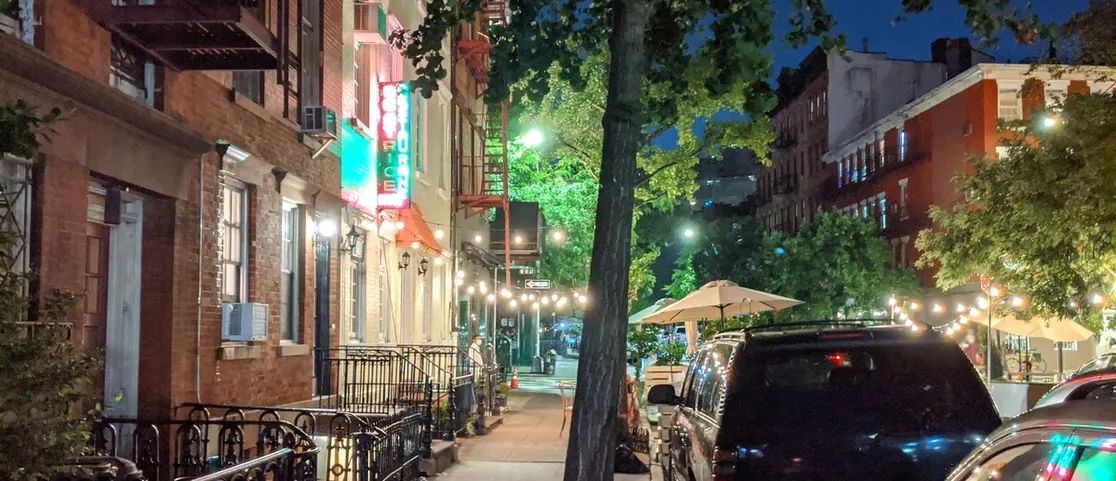
Mode two is the hotel-block evening. Walk five or ten minutes, eat somewhere easy, notice the neighborhood, buy water or breakfast basics, and return. This is the default that works for the widest range of travelers because it produces a first Manhattan memory without creating another transport chain.
Mode three is one nearby landmark or street. Times Square can make sense if the hotel is already around Broadway. Grand Central can make sense from Midtown East. A West Village street loop can make sense if the hotel is downtown and the walk is genuinely small. The landmark earns the slot because it is already inside the hotel geography, not because it appears on a “first night” list.
Mode four is one pre-existing must-do commitment. This is the exception. If the trip was built around a specific event and the timing is comfortable even after real arrival, keep it. Everything around it should become easier: meal nearby, no bonus neighborhood, no second ticket, and a direct route back.
Use a 90-minute radius around the hotel
A strong arrival night should be easy to abandon. Think of a rough ninety-minute envelope from leaving the hotel to being able to stop again. That might be a meal plus a few blocks, or a landmark plus a simple snack. It should not require two subway rides, a reservation you are afraid to miss, and a late return from the other end of Manhattan.
The key is not the exact ninety minutes. It is the exit. If someone says “I am done,” can the group be back at the room with one simple walk or ride? Arrival-night plans become bad when the most tired person has no graceful way to stop.
Let hotel geography write the evening
If you are staying around Times Square or Hell’s Kitchen, the first evening can be as simple as seeing the lights, eating nearby, and leaving the deeper Midtown plan for tomorrow. If you are in Midtown East, use the local streets, Grand Central area, or a nearby meal instead of crossing west because someone said the first night must include Times Square.
If you are on the Upper West Side, the first evening can be residential blocks, a simple meal, and an early return. Do not commute downtown for atmosphere you already have around the hotel. If you are in SoHo, Tribeca, the Financial District, or another downtown base, stay downtown. The where-to-stay decision should continue doing useful work after check-in.
This is why a first-night itinerary should never be copied without the hotel location. The same plan can be easy from one base and irrational from another. Manhattan is narrow, but cross-town and north-south corrections still consume time, walking, transfers, and attention.
Eat for certainty, not for status
Arrival night is a poor time to chase a famous restaurant across Manhattan. Choose something close, predictable, and appropriate to the group’s energy. A destination dinner belongs on a night when the meal can be the anchor. On arrival night, the useful meal is the one that does not create another clock.
If the arrival has slipped late, use late-night food by area rather than assuming the original dinner is still possible. Do not keep a 9:30 p.m. reservation simply because you made it at home if reaching it requires another cross-town trip. The sunk cost is smaller than turning a tiring travel day into a midnight logistics exercise.
Protect tomorrow morning before you rescue tonight
The most expensive first-evening mistake is borrowing energy from a morning that already matters. If Day Two begins with a fixed ticket, ferry, train, tour, or business obligation, decide the wake-up and departure time before you add a first-night activity. Then work backward: breakfast, shower, bags, subway or taxi, and the actual travel buffer.
A long first-night walk can be a poor trade even when everyone feels excited. The walking-load guide exists because enthusiasm can hide fatigue until the second half of the day. If tomorrow is the real first sightseeing day, keep tonight’s walking block intentionally small.
Late arrival changes the transport assumption
MTA publishes a separate late-night subway service map for roughly the overnight period, and planned service changes can alter the route you expected. PATH also publishes day and night patterns. The practical rule is simple: do not leave the hotel again after a late arrival using a route screenshot you saved earlier in the day without checking current service.
This is especially important after Newark arrivals or any trip affected by airport construction, pickup relocations, or rail work. The airport transfer guide owns the detailed route. WM-080 only decides what happens after that route is complete: if the transfer used more time or attention than expected, shrink the evening instead of trying to recover the original schedule.
Do not use Times Square as an arrival-night obligation
Times Square works on the first evening when it is already close, when the group still wants stimulation, and when you can leave after fifteen or twenty minutes. It does not work as a ceremonial requirement that forces an Upper West Side, downtown, or East Side traveler into another round trip after a long flight.
The same rule applies to Rockefeller Center, the Brooklyn Bridge, the High Line, or any other “quick first-night” suggestion. Close is good. Famous is not enough. A first evening should reward the hotel geography you chose, not punish it.
Families should make the radius smaller
Children often handle the excitement of arrival until the moment they do not. Build the first evening so food, bathroom, stroller, and sleep needs can end it quickly. A hotel-block meal and one short walk are usually more robust than a first-night attraction. If a stroller or stairs materially affect the route, use the stroller guide and accessibility guidance instead of assuming a nearby subway is automatically easy.
The same smaller radius helps older travelers, people carrying heavy luggage, and anyone whose travel day already involved several transfers. The correct first evening is allowed to look boring on paper.
Bad weather is permission to stop, not a challenge to salvage
If the arrival night is wet, very hot, very cold, or otherwise unpleasant, do not rescue the itinerary by crossing Manhattan for an indoor attraction. The travel day has already created enough transitions. Eat in the hotel, order food, use the lobby or bar, or choose one nearby indoor option. The rainy-day or seasonal guide can solve a full sightseeing day tomorrow.
Weather should reduce the radius, not merely replace the landmark. A plan with no outdoor walking can still be exhausting if it requires a long subway ride, another ticket line, and a late return.
A first-evening decision tree
- Hotel-ready after 10 p.m. or group clearly tired: food, essentials, sleep. No second neighborhood.
- Hotel-ready around 8–10 p.m. with moderate energy: one nearby meal plus a short walk; use late-night food only if the normal dinner window is gone.
- Hotel-ready around 6–8 p.m. with good energy: one hotel-zone anchor or neighborhood loop, then an easy meal and stop.
- Any arrival with an early fixed commitment tomorrow: downgrade one level from whatever you think you can handle.
- Any arrival with children, mobility constraints, poor weather, or complicated luggage: shrink the radius before adding an activity.
- If a plan needs two transit legs after hotel check-in, it is probably not an arrival-night plan anymore.
A practical example by hotel zone
Midtown West hotel: drop bags, eat around Hell’s Kitchen or Koreatown depending on the exact block, walk through Times Square only if it is already on the way, then stop. Midtown East: use Grand Central or a nearby street loop, not a west-side detour. Upper West Side: dinner, residential walk, maybe a park edge if it is still comfortable and open, then back. Downtown: stay downtown; a river edge, SoHo block, Tribeca street, or Lower Manhattan view is enough.
These are shapes, not restaurant lists. The right specific stop changes with the hotel, opening hours, weather, and actual arrival time. The structure stays useful even when the venue does not.
What not to book on arrival night
Do not make the first evening the home for anything that would hurt to miss. Avoid a non-refundable cross-town dinner, a sunset deck tied to flight timing, a second Broadway performance you added only because the calendar looked empty, or a ferry/cruise that requires precise arrival. The booking-priority guide explains which commitments deserve advance certainty. Arrival night is usually where you should spend that certainty sparingly.
If you already booked something fragile, define the failure plan before travel. What happens if the flight lands late? Can the reservation be moved? Is there a simple replacement near the hotel? If the answer is no, the booking is asking the travel day to be more predictable than it is.
Keep the specialist decisions separate
If the problem is still how to reach the hotel, return to the airport-to-Manhattan transport guide. WM-080 starts only after that transfer decision is complete.
If the hotel itself is making every first-night option awkward, use the where-to-stay decision guide rather than solving a bad base with more transport.
If the question is whether arrival night should contain a fixed reservation at all, use the pre-trip booking-priority guide before paying for something fragile.
If the group still wants to walk after check-in, size that plan with the Manhattan walking-load guide so tonight does not borrow too much from tomorrow.
If dinner has slipped beyond the normal window, switch to late-night food by area and keep the meal inside the hotel geography.
The first-evening rule in one line
Wait until the bags are down, check tomorrow morning, choose the smallest hotel-centered plan that still feels satisfying, and stop before the first night becomes a second travel day. Manhattan will still be there after breakfast.
Suggested Route & Mini Plan
- Wait until bags are down before deciding what the evening owns.
- Check tomorrow morning’s first fixed commitment before adding anything optional.
- Choose one mode: stop, hotel-block meal/walk, one nearby anchor, or one pre-existing must-do.
- Keep the evening inside one simple hotel geography; avoid a second neighborhood.
- If arrival runs late or energy drops, shrink the plan immediately instead of trying to recover it.
Curated Alternatives
Do nothing beyond food and sleep
Best when the hotel-ready time is late, the flight was tiring, children are fading, weather is poor, or the next morning has a fixed early commitment.
Use a hotel-block evening
Best default: one easy meal, one short walk, one recognizable local landmark or street, then back to the room without another transit decision.
Use one nearby must-do
Reasonable only when the group still has energy, the activity is truly close to the hotel, and missing or shortening it would not damage the trip.
Frequently Asked Questions
Should I plan sightseeing on my first night in Manhattan?
Usually only at hotel-neighborhood scale. Decide after the bags are down. If the group has energy, choose one nearby walk or landmark; if not, food and sleep can be the correct first-night itinerary.
Is Times Square good for a first evening in New York?
Yes if your hotel is already nearby and you can keep the visit short. It is a poor arrival-night obligation if reaching it requires another cross-town or long north-south trip after a tiring airport transfer.
What if my flight arrives late?
Reset the plan from the actual hotel-ready time. Check current late-night transit/service conditions, choose food close to the hotel, and remove any optional second neighborhood. Do not try to recover the schedule you planned from the landing time.
Should I reserve dinner for arrival night?
Only when the reservation is flexible or the hotel-ready time has generous slack. For most first trips, a nearby meal with no hard clock is safer than a destination restaurant that can be ruined by airport or transit delays.
What if I have an early tour or ferry the next morning?
Make the first evening easier. Work backward from tomorrow’s departure time and protect sleep, breakfast, transit, and buffer before adding any optional first-night activity.
Our recommendations are handpicked independently. No paid placement, no sponsored rankings. How we choose