
How Much Walking Should You Expect in Manhattan?
Plan Manhattan walking by time, energy, station overhead, and geography—not a fake daily step target. Learn when to walk, when to use transit, and how to compress an overloaded day.

⚡ At a Glance Overview
Make the Decision Fast
Plan walking by time, terrain, crossings, weather, and your group’s energy—not by a universal step target.
You are building a realistic first-trip pace and want to know when walking is part of the experience versus when transit saves the day.
Do not turn a step-count goal into the itinerary; stairs, long avenues, heat, crowds, children, and mobility needs change the practical load.
Why We Chose This
Existing WhyManhattan pages teach subway use, accessibility, stroller routing, and one-day/three-day geography, but none owns the general first-visit walking-load decision. This page connects those specialist rules without duplicating them.
Editorial Notes & Caveats
There is no universal Manhattan daily mileage or step target. Walking tolerance changes with age, fitness, weather, footwear, crowds, luggage, attraction type, station access, and health. This guide is planning advice, not medical guidance. If stairs, elevators, balance, pain, heat sensitivity, or mobility aids are material constraints, use the dedicated accessibility/stroller guidance and verify current MTA elevator/service status before travel.
You will probably walk more in Manhattan than the route line on your phone suggests. The surprise is not only the distance between landmarks. It is the extra walking inside subway stations, through museum galleries, around closed entrances, to restrooms, across broad avenues, back to the shop someone forgot, and through the final blocks from the station to the hotel when everyone thought the day was already over.
That is why “How many miles will I walk?” is the wrong first question. The better question is: how many chunks of walking can this day absorb before the next fixed commitment becomes annoying? A first visit should be planned around time, energy, geography, and recovery—not a universal step count.
Think in walking windows, not daily miles
NYC DOT’s WalkNYC wayfinding system is useful because it frames pedestrian geography in time. Its neighborhood maps commonly show destinations within roughly five to seven minutes and a larger walking horizon around fifteen minutes. Those are practical mental units for a visitor: a short connector, a normal local walk, and anything beyond that that deserves a real walk-vs-transit decision.
A five-minute connector rarely changes the day. A fifteen-minute walk can be delightful if it is on the route, the weather is good, and the group still has energy. Three separate fifteen-minute walks added around a museum, lunch, a subway transfer, and an evening show are no longer “just fifteen minutes.” They become the load of the day.
Do not add every visible walk on the map and call that the total. Add the hidden layers too: hotel-to-station, station entrance-to-platform, transfer corridors, indoor attraction walking, security lines, meal detours, and the walk after the final train. Standing counts. A museum day can be leg-heavy even when the street distance is modest.
Use three energy blocks: strong, moderate, easy
A simple first-visit framework is to give the day one strong walking block, one moderate block, and one easy block. The strong block is the part you intentionally want to experience on foot: Central Park, the West Village, the High Line and Chelsea, Lower Manhattan, or SoHo. The moderate block connects one or two nearby anchors. The easy block is the part that should not require heroics—often the evening return or the hours around a fixed ticket.
If your morning is a long park walk, do not build another long neighborhood walk before a Broadway curtain. If the afternoon is The Met or AMNH, remember that the attraction itself contains substantial standing and internal walking. A “museum plus walk” day can become a “museum plus recovery” day without anything going wrong.
The framework is intentionally relative. An energetic twenty-five-year-old and a parent pushing a stroller can both use it, but their strong block will not be the same size. The point is to stop pretending that every part of the day can be the hardest part.
Walk when the street itself is doing useful work
Walking is usually the better choice when it connects places you already want, keeps you inside one neighborhood, and replaces transit overhead rather than adding distance for its own sake. A local walk through the West Village, SoHo, Chelsea, Chinatown, or the Upper West Side can be part of the visit. You are not merely moving between pins; the blocks are the content.
This is where a short-to-moderate walk often beats the subway. Entering a station adds stairs or elevators, waiting, platform navigation, and another walk at the far end. If the destination is around the corner in the same geography, transit can save almost no energy. The Manhattan subway guide should decide the line; this guide decides whether the line is worth entering at all.
Use transit to reset geography, not to eliminate walking
The subway earns its keep when it turns a long north-south jump into one clean reset: downtown to Midtown, Midtown to the Upper West Side, or a hotel return after a neighborhood day. MTA’s trip planner explicitly lets riders compare fastest, fewest-transfer, and least-walking options. That is a reminder that “fastest” and “easiest on the legs” are not always the same route.
For a first visit, one or two meaningful transit resets are often more useful than hopping underground for every ten-block gap. Too many subway entries create their own fatigue—especially when entrances are on the wrong corner or a transfer requires a long mezzanine walk. Use transit to move between clusters, then let each cluster breathe.
Crosstown movement deserves a separate check. East-west subway coverage is less direct in many parts of Manhattan, so a bus, a street walk, or a taxi can be more rational than a route with a transfer. Compare door-to-door time and walking, not just the colored lines on the map.
A museum is a walking block even when the map says zero
Visitors routinely undercount museums because the map only measures the front door. The Met, AMNH, MoMA, and other large institutions ask you to stand, queue, change floors, find restrooms, backtrack through galleries, and walk from the exit to the next meal. A two-hour museum visit can consume more leg energy than a twenty-minute outdoor walk.
Treat the museum as the strong or moderate block, depending on the traveler. Then decide whether the neighborhood around it should be explored before or after—not both automatically. Museums with kids and the accessibility guide have more specific pacing rules when children, elevators, or limited stamina are the real constraint.
The hotel-to-first-stop walk counts every day
A hotel that is “near the subway” can still add a repeated ten-minute walk, a broad avenue crossing, and station stairs twice a day. That is not automatically bad, but it is part of the walking budget. A cheaper room that adds friction to every morning and every late-night return can create more fatigue than a busier hotel in the right geography.
Use the where-to-stay decision before you solve daily walking. Your base changes which walks repeat. A traveler staying near Broadway has a different evening load than someone returning downtown after every show. The walking plan should begin at the hotel door, not at the first landmark.
Heat, rain, and cold change the same route
Weather does not simply make walking less pleasant; it changes how much walking the day can support. NYC Health treats extreme heat as a real safety issue and recommends hydration, shade or cooling, and breaks during hot conditions. On a heat day, shrink the strong walking block, move it earlier or later, and give the middle of the day to an air-conditioned anchor. Use the summer guidance when heat is the main problem.
Rain adds umbrellas, wet crossings, slippery entrances, and the temptation to use a subway for very short distances. Sometimes that helps; sometimes the station detour creates more hassle than a direct walk. The rainy-day guide owns the indoor itinerary. Here the rule is simpler: reduce outdoor connectors and stop pretending the original dry-weather route still has the same energy cost.
Stairs and accessibility can make a short route the wrong route
A route with fewer street minutes can still be worse when it depends on stairs, a long transfer corridor, or an elevator that is out of service. MTA’s trip planner includes least-walking and accessible-trip options, but live elevator and service conditions still matter. If those constraints affect your trip, use the stairs-and-crowds accessibility guide rather than relying on a generic walking estimate.
The same applies to strollers. A stroller can make a flat twenty-minute walk easier than a short subway trip with vertical obstacles. The dedicated stroller guide owns that equipment-specific decision. WM-079 only supplies the general rule: walking load is the full route burden, not the number printed beside the walking icon.
How to compress a day when the map is too ambitious
When a first draft has too much walking, do not trim five minutes from every stop. Remove the wrong geography. Keep the places that naturally connect and cut the outlier. If the day is Midtown plus Central Park, a downtown food detour is usually the problem. If the day is Lower Manhattan, a quick Upper East Side museum is not quick because the attraction is small; it is expensive because the geography breaks.
- Remove the farthest pin that requires a separate transit reset.
- Keep the next meal near the current neighborhood instead of crossing town for a famous name.
- Use the subway for the one long north-south reset and walk inside each cluster.
- Replace a second museum or observation deck with a seated meal, park edge, bookstore, or neighborhood stop.
- Move shopping to the part of the day when you are already near the stores; carrying bags makes every later walk harder.
- Protect the evening fixed commitment by making the two hours before it intentionally easy.
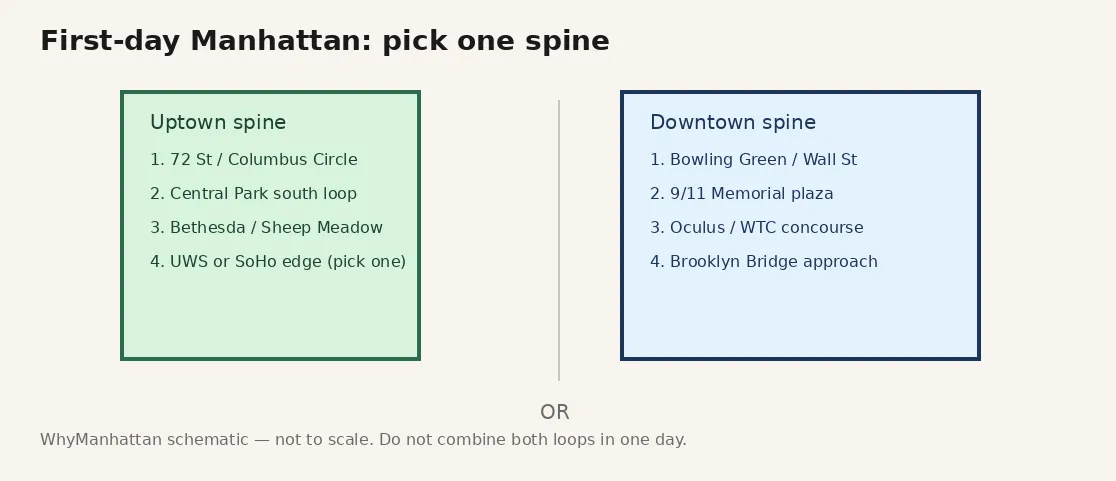
This is why the one-day and three-day Manhattan guides use geographic spines rather than landmark counts. Backtracking is not just a time problem. It is a walking-load problem disguised as ambition.
A realistic first-day walking pattern
Imagine a first day with one downtown cluster and an evening in Midtown. The morning strong block is Lower Manhattan on foot. Lunch happens inside that same geography. The afternoon uses one subway reset to Midtown and one moderate walk around the next anchor. The evening stays easy because the show, dinner, or hotel is already nearby. The day still contains a lot of walking, but it does not ask the same legs to cross Manhattan three times.
Now compare the overloaded version: downtown morning, SoHo lunch, Central Park photo stop, hotel change, pre-theater dinner, Broadway, Times Square, and a late dessert downtown. None of those individual walks looks absurd. The day is absurd because every transition consumes another piece of walking and standing capacity.
Use the 3 p.m. test
Before finalizing an itinerary, ask what the group will feel like at 3 p.m. If the answer is “we will already have spent the morning in a museum, crossed two neighborhoods, and stood through lunch,” do not schedule the hardest walk next. If 3 p.m. is still the beginning of the interesting part of the day, make the morning easier.
The same test works during the trip. If the group is more tired than expected, compress immediately. Take the transit reset sooner, eat where you are, drop the lowest-priority pin, or go back to the hotel. Waiting until everyone is exhausted turns a small adjustment into a taxi, missed reservation, or argument.
Use the specialist guide when walking is not the whole problem
For a first-day route that already needs ruthless geographic cuts, continue with the one-day first-visit spine instead of adding another walking rule.
For a multi-day trip, move from daily energy to the three-day geography plan so the same cross-town mistake does not repeat each morning.
If line choice and station direction are the real problem, use the first-time subway guide rather than making this page do transit instruction.
If stairs, elevators, balance or crowd pressure are material constraints, switch to the stairs-and-crowds accessibility guide and check current MTA accessibility status.
If the route depends on stroller handling, use the Manhattan stroller guide for equipment-specific route choices.
If the walking question is really about what to do after a flight and hotel check-in, use the first-evening guide and keep the arrival-night radius deliberately smaller.
The final call
Expect Manhattan to contain more walking than the map suggests, but do not solve that uncertainty with a fake daily mileage target. Think in five-to-fifteen-minute walking windows, count museums and station circulation as load, give each day one strong walking block, and use transit to reset geography. The right amount of walking is the amount that leaves enough energy for the part of the day you actually came to experience.
Suggested Route & Mini Plan
- Mark one strong walking block, one moderate block, and one intentionally easy block.
- Use 5–7 minute and ~15 minute walks as planning windows instead of a daily mileage target.
- Count museum walking, queues, station circulation, and hotel connectors as part of the load.
- Use transit for the long geography reset; walk within the cluster.
- At 3 p.m., cut the farthest remaining pin if the group is more tired than expected.
Curated Alternatives
Use a one-geography day
Best when you want Manhattan to feel easier: choose one cluster, take one transit reset at most, and let the rest of the day happen on foot inside that geography.
Use transit-first days
Better for travelers with lower walking tolerance, bad weather, children, or fixed reservations far apart. Use the subway or bus to reset geography and preserve legs for the attraction itself.
Use a walk-heavy neighborhood day
Works for energetic visitors when the walking is the attraction: West Village, SoHo, Chelsea, Lower Manhattan, or a park-led day. Keep the evening intentionally easy.
Frequently Asked Questions
How many miles should I expect to walk per day in Manhattan?
There is no useful universal number. Hotel location, museums, subway transfers, weather, luggage, children, and walking tolerance change the total. Plan in walking windows and energy blocks instead of using a fixed daily mileage target.
When is it better to walk instead of taking the subway?
Walking is often better for a short-to-moderate connection inside the same neighborhood when the street itself is part of the visit. Subway becomes more useful for long north-south resets, fixed-time commitments, or when weather and energy make the walk a poor trade.
Does museum time count as walking load?
Yes. Galleries, queues, stairs or elevators, restrooms, and standing all consume leg energy even when the street map shows almost no distance. Treat a large museum as one of the day’s major walking blocks.
How can I reduce walking without missing Manhattan?
Keep each half-day inside one geography, remove the farthest outlier, use transit for the long reset, eat near the current cluster, and protect the hours before a fixed evening commitment. You usually need fewer neighborhood jumps, not more taxis.
What if stairs or elevators are the real problem?
Use the dedicated accessibility guide and current MTA accessible-trip/elevator information. A route with fewer street minutes can still be much harder if it depends on stairs, long transfers, or an elevator outage.
Our recommendations are handpicked independently. No paid placement, no sponsored rankings. How we choose